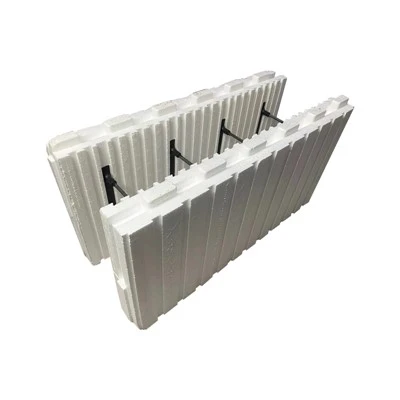
Extruded polystyrene (XPS) boards have a closed-cell honeycomb foam structure, where each cell is surrounded by surrounding cells and not connected to other cells. This closed-cell structure makes XPS boards virtually non-absorbent, exhibiting extremely low water absorption. During the continuous extrusion process, XPS boards achieve a uniform cell distribution and thicker walls between cells. This uniform density and cell distribution contribute to stable physical properties, such as low thermal conductivity and high compressive strength.
Thermal conductivity is a core indicator of a material's insulation performance. The thermal conductivity of XPS boards typically ranges from 0.028 to 0.035 W/(m·K). Compressive strength is the ability of XPS boards to resist deformation under pressure, typically ranging from 150 to 700 kPa. Density refers to the mass of material per unit volume; the density of XPS boards ranges from 25 to 45 kg/m³. Water absorption rate measures a material's ability to absorb moisture upon contact with water; XPS boards have an extremely low water absorption rate, typically less than 1%.
The thermal conductivity and compressive strength of XPS extruded polystyrene (XPS) boards are interrelated and mutually influential. When the closed-cell ratio is high, and the cells are uniform and dense, air circulation is poor, heat transfer is difficult, and the thermal conductivity decreases. Simultaneously, such a structure can better withstand external forces, resulting in higher compressive strength. Within a certain density range, generally, increasing density increases the compressive strength of XPS boards. However, increasing density also makes the closed-cell structure denser, reducing gas permeation and causing a certain degree of decrease in thermal conductivity. Once the density exceeds a certain value, further increases in density may increase the thermal conductivity, while the compressive strength may still improve, but the rate of increase will gradually decrease.